
Collectors, is 2026 the year big brands lean into collectibles? That’s the case Gary Vaynerchuk makes in his recent essay, “The Most Underrated Marketing Move of 2026: Physical Collectibles”.
Gary argues that collectibles are no longer just a niche, and they can be a scalable tool for brand storytelling, differentiation, and community building. From cereal boxes to luxury flights, smart brands are using collectibles as lifestyle signals, trial incentives, and shareable moments.
We’re obviously bullish about the collectibles space here at Mantel, and we love hearing about non-collectible brands playing in our space (like the Crocs x Legos collab we mentioned in our Tuesday newsletter). But as Gary warns, to win with collectors, brands can’t just create cheap tchotchkes (lots of silent T’s in that word). Without authenticity, rarity and good storytelling, it’s damn near impossible to create something that people want to place on their mantel vs. toss in the back of a closet.

Credit: The Realest
Selling snow and grass can really pay off, apparently! The Realest just announced that they’ve raised $12M from investors including the MLBPA to scale its authentication tech and event-based collectibles model (like snow from an Eagles football game). The company is betting that the future of sports memorabilia lies in remixing formats—turning athletes into artists, moments into vinyl, and fan obsession into authenticated art. In a hobby defined by scarcity and story (see my intro above…), The Realest is building both.
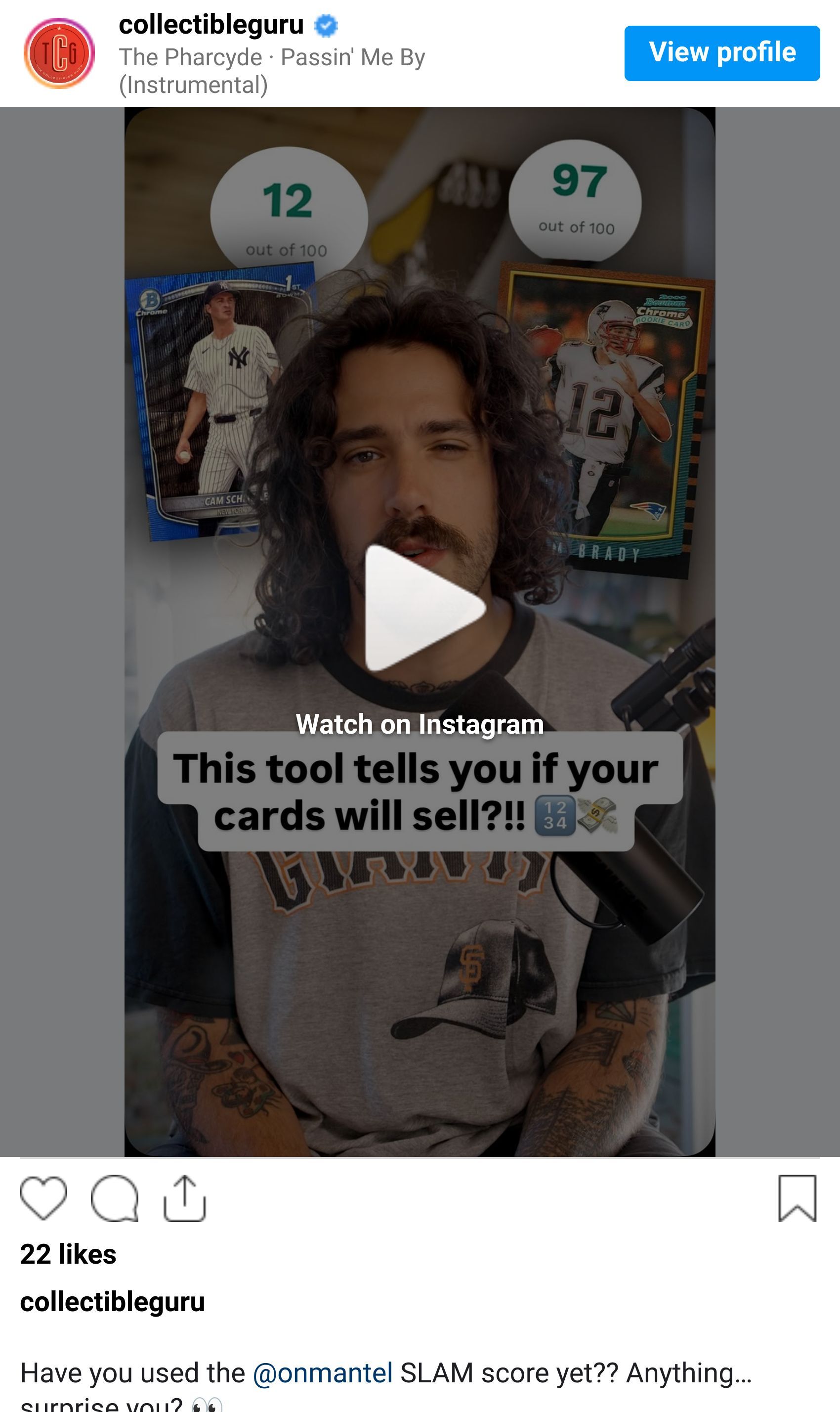
Had to include this article and the IG post above, didn’t I!? Mantel’s new SLAM Score, launched last week, aims to solve a common pain point in the hobby: knowing what a card is worth isn’t the same as being able to sell it. SLAM—short for Secondary Liquidity & Momentum—scores cards from 0–100 based on how easily and consistently they’re selling, factoring in volume, velocity, and volatility. I’m excited to reference the data at a slate of upcoming card shows here in LA as I try to pad my Dodgers PC before the new season starts…
BTW: If you use Mantel, we’d love to get your feedback on our latest feature releases. Please help us continue to improve the platform by filling out this 5-minute survey.
Whatnot dropped their new State of Live Selling Report yesterday, which reinforces that sports cards remain the backbone of the platform’s $8B live-commerce boom, even as lifestyle categories surge. In the U.S., sports cards rank No. 1 by volume, with over 6.4 million sold monthly (equates to more than two per second). Streamers who go live daily average $69K/month, and sellers earning over $1M in lifetime sales more than doubled in 2025. From sealed Bowman Chrome boxes to regional standouts like Boca Raton’s $3M/month shop, the hobby’s live-selling engine shows no signs of slowing.

Credit: @tullacollects on Instagram
The One Piece: US Voyage college basketball tour is quickly becoming the smartest collectible activations of the year. By pairing school-specific posters, co‑branded t‑shirts, and a limited Monkey D. Luffy promo card at select Rutgers, Houston, Gonzaga and Illinois games, the campaign turns a simple giveaway into a multi‑stop chase. The result is immediate secondary‑market demand, with Luffy cards already selling north of $375, and ticket prices for the giveaway games skyrocketing. Which is welcome news to Rutgers ticket-sellers, given the team is currently 9-12.

Credit: PSA via cllct
If you haven’t scoured your attic yet for rare and valuable sports cards, what are you even doing?! A 1933 Goudey Babe Ruth card signed by the Bambino himself, found in a Pennsylvania scrapbook in 2019, is for sale at Goldin where it’s already drawn a $793,000 bid. The card is the highest-graded autographed Ruth Goudey known to exist and should top $1M, given a similar example with slightly lower grading sold privately for $1.2M. I’ve looked in my attic for similar bounties multiple times, but unless anyone is paying 7-figures for cobwebs and rat droppings, no big payday coming.
Topps released its 2025/26 Chrome Sapphire Basketball box this week via an EQL raffle for $999, and the secondary market reaction was instant chaos, with shops like Dave & Adam’s buying up boxes from resellers for north of $2,500 before listing them at $5,999. With just 32 cards and one auto, it’s a wild price point, driven almost entirely by Cooper Flagg lottery tickets and FOMO-fueled hype. The odds of hitting anything close to the box value are slim, but shoutout to Topps for choosing fairness (EQL) over frenzy (Dutch auction).

Credit: Nicky Bay via NYT
Isopods, those tiny crustaceans better known as pill bugs (or depending on where you are from, roly-polys or even, shudder, doodlebugs) have become a high-stakes collectible. At a recent expo, neon-orange Cuban Spiky isopods were listed at $350 per cup (that’s Cooper Flagg-type money!), given their rarity and wild appearance. These collectible creatures are now the subject of growing concern among conservationists, with many being poached from protected areas and sold through largely unregulated channels, risking extinction for species science barely understands. Likely the first time we’ve written about collectible bugs, but the article compared them to Pokemon characters, so it felt like Above the Mantel material.
